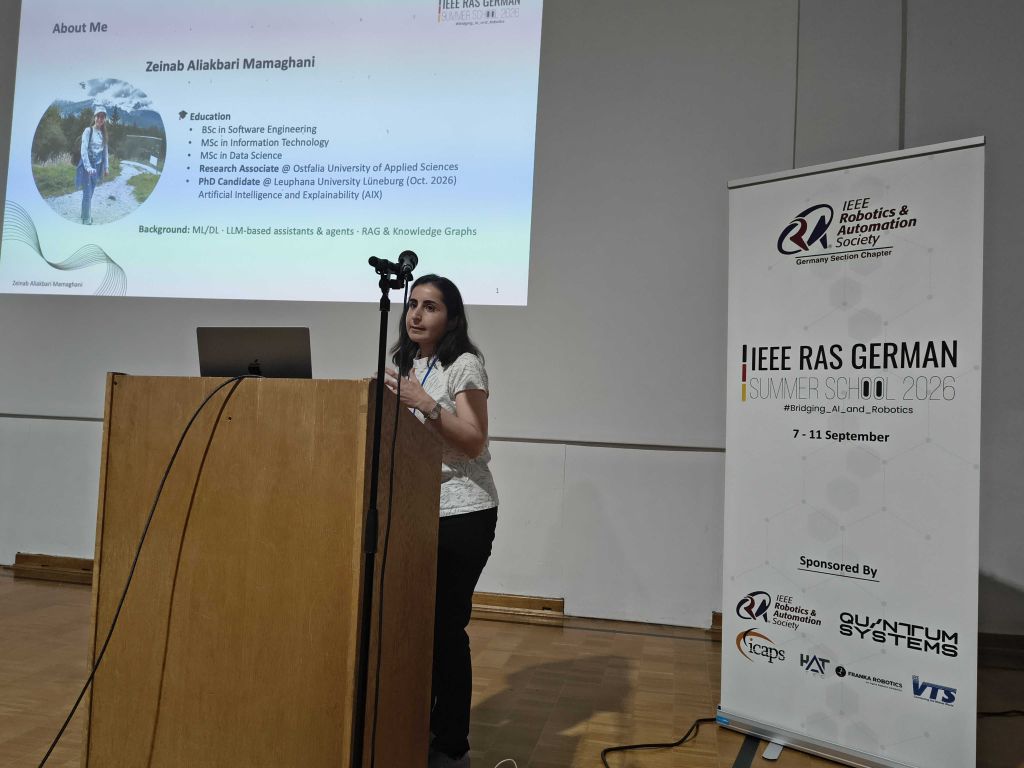
We are very pleased that our colleague Zeinab Aliakbari Mamaghani had the opportunity to participate in the IEEE RAS German Summer School 2026—an intensive, internationally oriented program on decision-making in cognitive robotics. From September 6 to 11, 2026, approximately 45 early-career researchers from across Europe and beyond gathered on Fraueninsel in Lake Chiemsee to discuss current developments at the intersection of AI and robotics. In the following, she herself recounts what she experienced, learned, and took away for her own research:
From 6–11 September 2026, I had the opportunity to participate in the IEEE RAS German Summer School 2026, “Decision Making for Cognitive Robotics: Where AI Meets Robotics for the Next Generation of Researchers,” held at Fraueninsel on Lake Chiemsee, near Munich.The Summer School is inspired by the original series established at MIT/SCLI and this edition was independently organized and hosted by the IEEE RAS Germany Chapter. I participated as a PhD candidate at Leuphana University Lüneburg, with the support of Prof. Dr. Ricardo Usbeck.
It was a really intensive Summer School, bringing together around 45 participants from a diverse range of countries, including Germany, India, France, Italy, Spain, the UK, Switzerland, the Netherlands, and Poland. The Summer School received a high number of applications and attracted an exceptionally strong pool of candidates. Due to its limited capacity, only around 60% of applicants were accepted, based on their CVs, current research projects, and motivation. This created a highly international and interdisciplinary environment and provided a valuable opportunity to exchange ideas and experiences with other PhD students and early-career researchers working in robotics and AI.
The programme covered a broad range of topics around humanoid and embodied robotics, with a particular focus on how robots can operate more independently in environments such as homes, stores, and factories. The lectures addressed questions such as how robots can learn and perform tasks, how planning and execution can be handled in autonomous systems, and how robots can adapt their skills to complex environments.
Among the topics covered were planning and execution for autonomous robotics; planning, representation, and learning of planning models and policies; neuro-symbolic approaches; scene graphs for mobile manipulation; inductive biases for robotic learning; interactive skill adaptation; humanoid locomotion and manipulation; motion discovery; human-to-humanoid robotics; exploration in reinforcement learning; and behaviour foundation models and Vision-Language-Action (VLA) models, including approaches for fine-tuning these models.
I particularly enjoyed the lectures and discussions by Hector Geffner and Brian Williams, as well as the topics around scene graphs and concept graphs, VLA models, and neuro-symbolic approaches to task and motion planning.
These topics were especially interesting to me because they connect closely with areas I am already exploring. Before attending the Summer School, I had already been working on challenges related to scene understanding, knowledge representation, and reasoning. During the lectures, I encountered several of the same challenges and limitations that I had also observed in my own experiments and testing scenarios. This made the Summer School particularly valuable for me, as I could connect the theoretical approaches discussed by the lecturers with problems I am currently working on.
Overall, the Summer School gave me the opportunity not only to learn about different approaches in cognitive and embodied robotics, but also to reflect on my own research from a broader perspective and to explore how ideas from VLA models, scene graphs, planning, and neuro-symbolic reasoning could contribute to the development of more capable and trustworthy robots.